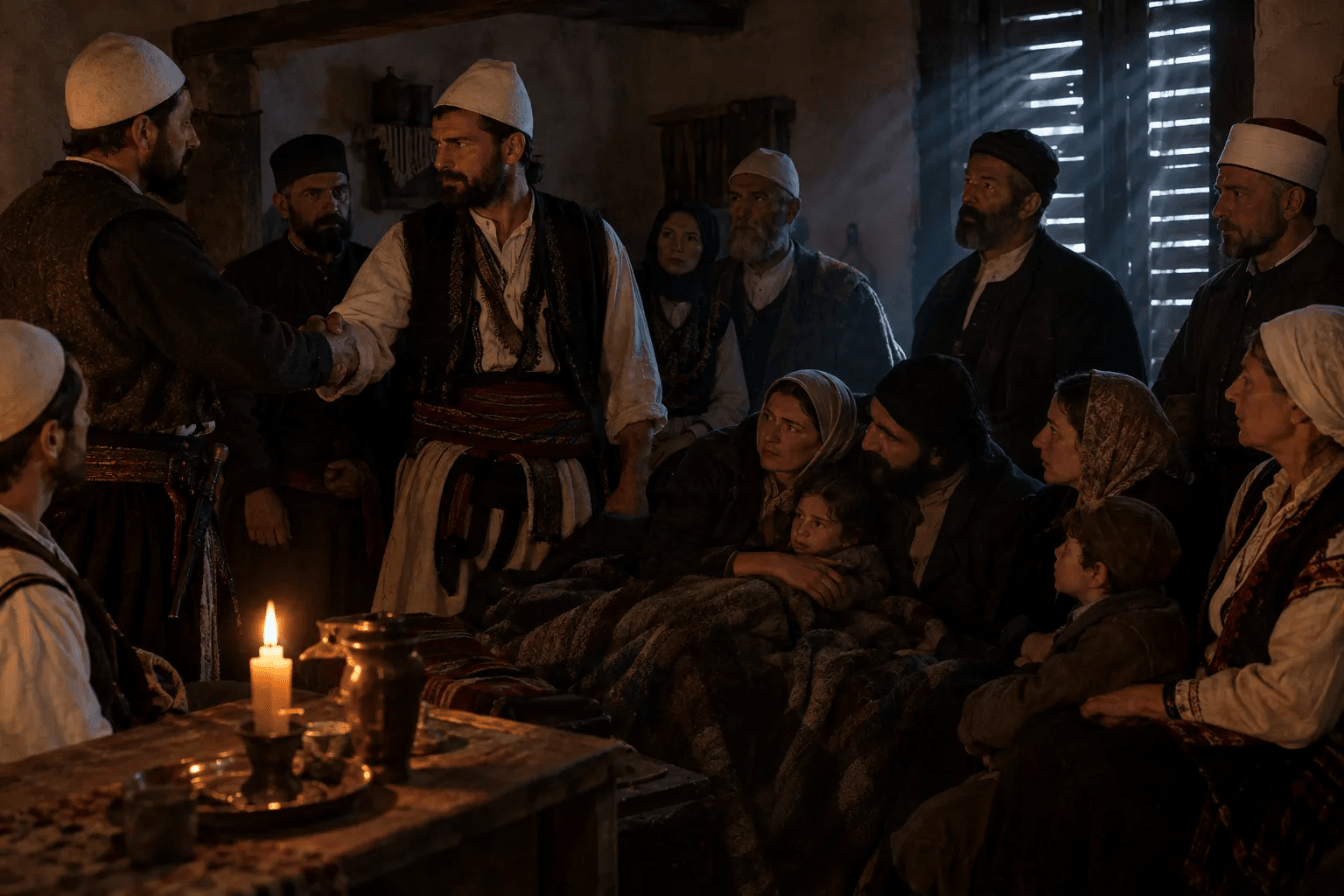
Besa: The Word That Defines a People
In the Albanian language lives a word that carries within it the very soul of a nation—besa, a concept so deeply woven into the fabric of Albanian identity that it cannot be fully translated into any other tongue. This is the story of how a single principle of honor, faith, and moral obligation shaped a people through centuries of struggle.
Nestled in the heart of the Balkans is a land of resilience, tradition, and unyielding pride. Despite centuries of occupation by Romans, Byzantines, Ottomans, and even communist rulers, the Albanian people never lost their identity. Through relentless struggle to preserve their culture, they held fast to core principles that defined them. Among these principles stands one word—besa—that embodies the very essence of what it means to be Albanian. Besa is not merely a word; it is a semantic component so characteristic of the Albanian people that other languages lack the corresponding equivalents to capture its full meaning. As an autochthonous notion rooted in Albanian soil, besa can be clearly understood only in its source language, only in Albanian.
Besa emerged from the earliest periods of tribal life among the Albanian ancestors and extends into different spheres of individual, social, and national existence. It contains within itself a complex of values, virtues, and ethnopsychological characteristics that distinguish this people from all others. As an inseparable component of individual ethics, besa became identified fully with the fate of the Albanian people through the centuries—a virtue of an ancient people, a moral obligation sanctioned by the very life they lived. It served as a traditional norm for a people that passed through terrible storms of history, and as a juridical norm for those who never submitted to the state institutions of occupiers. Instead, Albanians solved their existential problems independently, on the basis of their own kanun norms, making besa a permanent ethnopsychological component of the entire nation.
Besa is the synthesis of virtues—a single word containing bravery, manliness, loyalty, self-denial, and human sacrifice for the general good. As an ethical and aesthetic ideal connected with the very purpose of human existence, besa conditioned social relations and the manner of action for individuals and entire communities. It was implanted in every form of folk creativity and testified throughout the entire folk culture of the Albanian people. Scholars, poets, prose writers, dramatists, and historians from Barleti to the present day have recognized and valued besa highly in their work. It appears in everyday speech through simple affirmations—'besa yes' and 'besa no'—and extends through proverbs, lyric poetry especially of love, and into the longer legendary and historical epics that form the heart of Albanian culture.
In the legendary epic of the kreshniks, besa functions as a sacred cult and distinguishing virtue. It characterizes the heroes and even mythological beings of these songs, setting them apart from their opponents who embody baseness, cunning, and faithlessness. The kreshniks give besa to guests to protect them from dangers; they give it to one another to stay strong before difficulties and to undertake actions demanding extraordinary courage and bravery. In one renowned song, 'The Marriage of Halil,' the hero himself affirms that even with opposing forces, besa could be given and honored. Through the institution of besa, relations between warring parties were regulated, and truces of peace were concluded according to the ancient norms of kanun life in the highlands of the north.
The true power of besa revealed itself during the darkest hours of Albanian history. During World War II, when Nazi forces occupied Albania, the principles of besa were put to the ultimate test. Albanians of all faiths—Muslim, Christian, and non-believer alike—risked their lives to protect Jewish families. They hid them in their homes, forged documents, and guided them to safety. Remarkably, Albania was one of the only Nazi-occupied countries where the Jewish population increased by the end of the war. To Albanians offering protection was not a choice but an obligation; breaking one's besa was unthinkable, for it would bring dishonor not just to the individual but to the entire family. The principle of besa extended beyond these heroic acts into everyday life—neighbors helping one another, strangers being treated like family, promises kept even under the most challenging circumstances.
Today, besa continues to inspire Albanians and non-Albanians alike, a reminder of the profound impact of keeping one's word and standing up for what is right even in the face of great danger. This is the word that guided a nation through occupation and turmoil. This is the principle that transformed a people fragmented across centuries into a unified force bound by honor, faith, and moral obligation. Besa is not simply a translation waiting to be found in another language—it is the defining word of the Albanian people, a synthesis of everything they have endured, everything they have valued, and everything they continue to be.