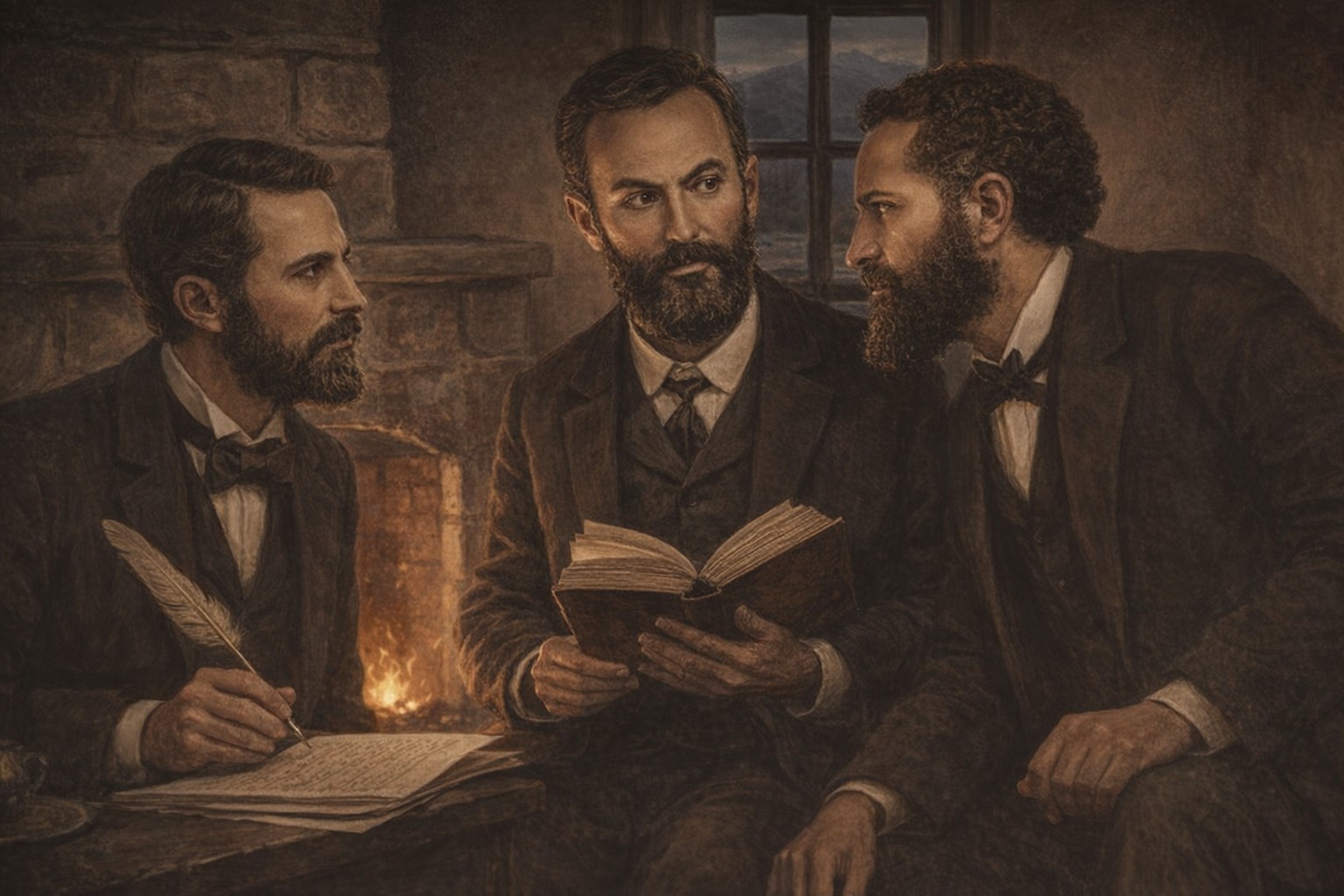
Three Brothers, One Nation: The Frashëris Who Remade Albania
Abdyl, Naim and Sami Frashëri came from a once-great village in the mountains and set out to rebuild a nation, each with his own weapon: diplomacy, poetry and thought. Their story is of a single national work written with three hands.
Frashër was never an ordinary mountain village. In the nineteenth century it was a true center on the trade routes, a Derbend village whose people were exempt from taxes in exchange for guarding the roads, with over twenty neighborhoods and around three hundred inhabited houses. Here the powerful Halit Bey Frashëri, a leader of the Toskëria elite who appeared in the uprisings of his time, raised eight children. Three of them, Abdyl, Naim and Sami, would carry the name far beyond the mountains. They took their first lessons in the Bektashi tekke of Baba Alush and later Baba Abedin, then studied at the famous Zosimea gymnasium in Ioannina, where six years of sciences, arts and classical and modern languages gave them a wide culture. The Empire noticed their brilliance and drew them to Istanbul, as it did with the children of the Albanian elite.
In Istanbul, while holding posts in the administration, they helped found the Istanbul Committee in 1877. It united Albanians scattered across the empire, without distinction of region or religion, and it carried the Albanian question to the great powers. Abdyl rose as the figure of the hour. He argued in the press of 1878 that Albanian lands must not be conceded, warned of a return of the age of Skanderbeg, and became the political mind of the League of Prizren. He stood at the assemblies of Dibra and Preveza, and in 1879 he toured Rome, Paris, London, Berlin and Vienna with Mehmet Ali Vrioni. For the first time Albanians spoke directly in the capitals of Europe, and Abdyl made plain that the threat from the Slavs in the north was the same as the one from the Greeks in the south.
The price was heavy. Arrested near Elbasan in 1881 after the League was crushed, Abdyl was sentenced to death, pardoned, and held for almost three years in the fortress of Prizren in tragic conditions, a message to every patriot who might dream of another uprising. He was released only because of pressure and failing health, and he died on 23 October 1892, aged 53, poor and broken in body.
Naim took up the pen. From his modest posts in Berat and the port of Sarandë he pushed Albania's cause forward, and in 1886 his books poured out in Bucharest, among them Bagëti e Bujqësi and Lulet e Verës. He wrote the Vjeshat, the epic for Skanderbeg, and translated the first song of Homer's Iliad. Poetry for him was a mission. He secured the permit in Istanbul for the first fully national Albanian school, opened in Korçë in 1887, whose children learned from the books of Naim, Sami and Jani Vreto. With his words he helped dam the flood of orientalisms and shape the modern literary language. He died in 1900, aged 54.
Sami, the youngest, gave the movement its mind. He wrote Besa for the Imperial Theatre in 1874, to show the Turks the virtue of the given word, and it was banned within a year. He stood at the center of the Society for the Printing of Albanian Letters in 1884, and its alphabet is more or less the alphabet of today. He wrote one of the first modern grammars of Albanian, the six-volume encyclopedia Kamus al-Alam, and in 1899 the manifesto Albania What It Was, What It Is and What Will Become of It, which named Skanderbeg as the first uniting, state-forming figure and dreamed of schools, a strong economy and democracy. The Porte identified the anonymous author and shut him inside his home. He died in 1904, aged 54, leaving debts that the family paid by selling the house, and a library of some 20,000 titles.
Abdyl in politics and diplomacy, Naim in literature and education, Sami in thought and ideology: they moved toward one goal, like a single national work written with three hands. They rest in the same Bektashi cemetery of Istanbul. They sought no chairs and no power, but melted down everything they had to build a nation. Albania has not honored them as it should, and that is the measure of how much they gave.