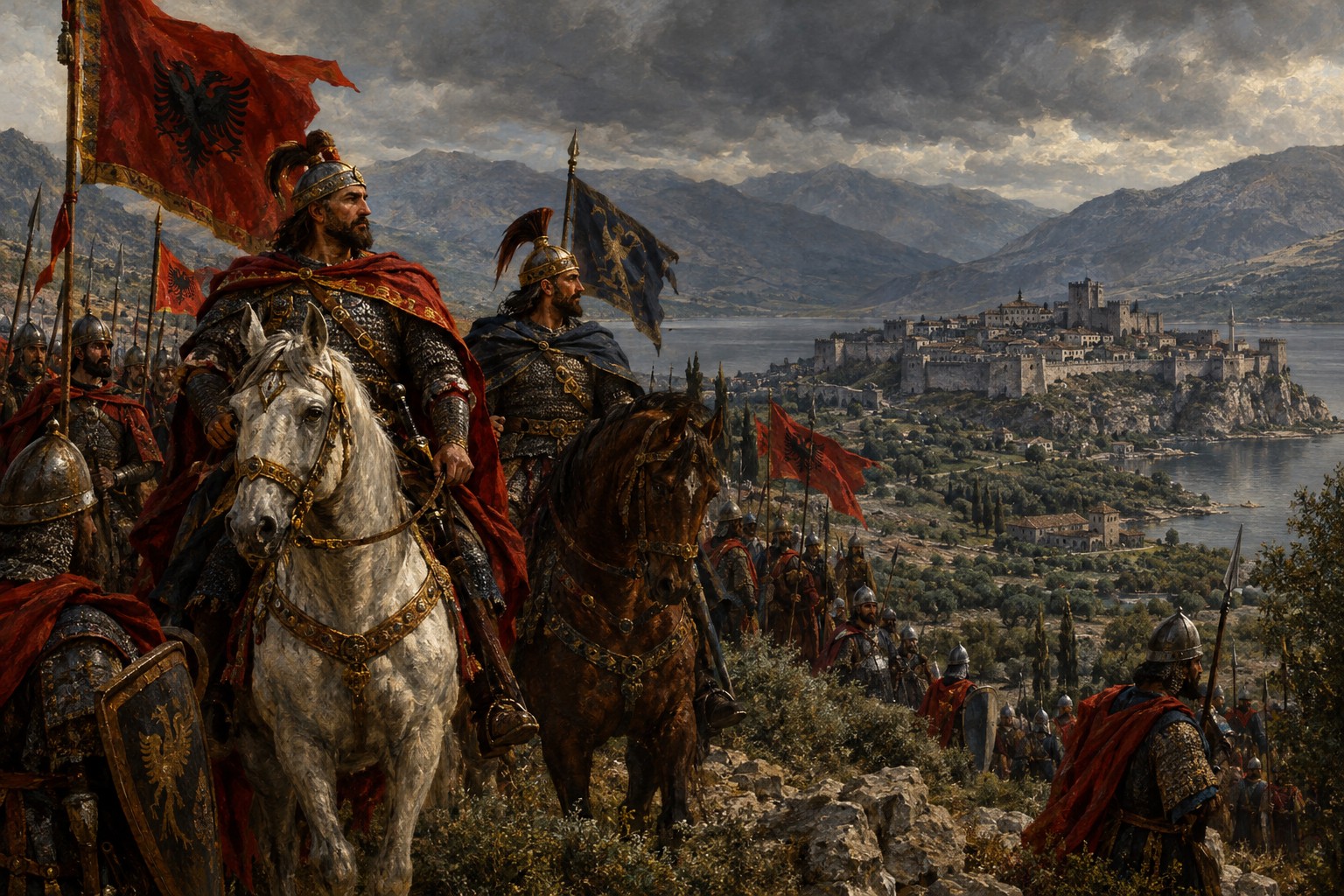
The Despots of Southern Arbëria: How Gjin Bua Shpata and Gjon Zenebishi Challenged Empires
For decades, two Arbëror noble brothers stood against the great powers of Europe and the Ottoman advance, defeating Aragonese grand masters and Italian rulers in their struggle to liberate Ioannina and command the southern lands.
After 1380, the battles for Ioannina between the Arbëror nobles and Thoma Preljubović, the city's occupying ruler, grew ever more fierce. Understanding the strength ranged against him, Preljubović first sought marriage alliances, then turned to more desperate measures. He called for the support of the Turks after 1380, bringing in military power from the occupiers who had already taken Macedonia. Yet even with these new alliances and heavy cooperation with foreign forces, Preljubović could not endure. According to the Chronicle of Ioannina, he was killed by his own guards one morning in 1384—though suspicion remained that his wife and the Arbërors themselves may have had a hand in his death. The powers of the time were playing all the strings and links among them, determined that power in Ioannina would not pass into the hands of the native Arbëror nobles.
An Italian was brought from the islands to replace him: Esau de' Buondelmonti Acciaioli, a prince from the Florentine family, placed at the head of Ioannina in 1385. Esau married the widow of Preljubović himself and immediately followed his predecessor's path. The first thing he did was present himself to the Turks and swear vassalage, securing Ottoman support against the Albanians. When fierce battles with Gjin Bua Shpata made clear that war alone would not serve him, Esau sought another solution: marriage. In 1395, after his first wife died, he bound himself to Irena, the daughter of his enemy Gjin Bua Shpata. In the Middle Ages, such marriages between the heads of tribes and princes were typical ways to create calm and peace. For a time, Esau believed he had secured his power.
But the Arbërors wanted to liberate Ioannina, and this marriage changed nothing. Around 1400, near Dhivër not far from today's Sarandë, Esau marched out from the walls of Ioannina to confront Gjon Zenebishi militarily. Despite his large army, he was routed and captured. Only the intervention of his father-in-law Gjin Bua Shpata with Gjon Zenebishi saved him—a delicate dance of war, alliance, and family that defined this age. The history of these Arbëror nobles had frequent changes and tangled turns: wars, alliances, political marriages, various agreements. All could be found in this important historical period. The family coats of arms testified to their standing. The Zenebishi bore an eagle with one head, two wings open upward and crowned, showing the title of despot. The Bua family displayed a golden lion in a field of red, holding a globe in one hand to show church power and a sword in the other for combat force—also crowned with the title despot.
The power of Gjin Bua Shpata and Gjon Zenebishi first came to the attention of the great western noble families in 1378, when they stood as a united coalition against Juan Fernández de Heredia, the Aragonese grand master of the order of the Hospitallers of Rhodes. Supported by Venetian forces, the papacy, and other great powers, Heredia sought to take possession of all Epirus. Instead, he was routed and captured by the Arbërors. This victory shook the western world and made them understand that these were no mere local chieftains but princes appointed with the title of Despot—a rank equivalent in value to the kings of Western Europe. The large Arbëror mass, lined up beside its three main leaders over several decades, broke considerable organized forces of the great kingdoms. Their success found its point in union, wide coordination, and the setting aside of the spirit of competition. In 1358, they had defeated the army of Nikephoros II, who was killed in battle. Then for a long time, great confrontations with Thoma Preljubović developed. In 1378, Gjin Bua Shpata and Gjon Zenebishi defeated Juan Fernández de Heredia. In 1399, the same fate befell Esau Buondelmonti.
On 28 April 1400, Gjin Bua Shpata closed his eyes in natural death. The Chronicle of Ioannina recorded that he was an honest man, a strong man, the glory of Arbëria—the final epigram written for this great leader. The tribe of the Shpatas shone not only in Epirus but across Europe in the centuries that followed. Meanwhile, Esau Buondelmonti, two years after the death of the noble who had saved his life, separated from his daughter and married a third time—again an Arbëror, Evdokia Balsha, whom the chronicle called despotess of Ioannina. After Esau's death in 1411, Evdokia governed the despotate herself, though not without struggle.
After the death of Gjin Bua Shpata, the fierce battles returned. Carlo Tocco, part of an Italian family descended from the Angevins of Naples, advanced with ambitions to rule southern Arbëria. Through betrayals and surprise attacks, he occupied territories of the Shpatas, but in 1402 he confronted the brother Zguro Bua Shpata at a fortress in Acarnania and was crushed. The Chronicle of the Tocco testified that Carlo Tocco risked leaving his head, and the Shpatas retook the fortresses he had occupied. Yet the coalition of the three great Arbëror princes was weakening. In 1411, Carlo Tocco took control of Ioannina and in 1412 descended to confront Gjon Zenebishi, the most powerful remaining of the former trio. Again in the same space near Mesopotam and Dhivër, Tocco's army suffered great losses, with all main commanders taken prisoner. He returned to Ioannina with only a handful of men. The strength of the Arbëror princes was extraordinary—it sprang from the people, from the autochthons of Epirus. But Ottoman pressure increasingly grew, and the first Arbëror territories were already falling to occupation. The once durable coalition was no longer the same. The successors of Gjin Bua Shpata became weak and hungry for power, finding themselves in rivalry among themselves. After the death of his nephew Muriq Shpata, Jakup Shpata took power but was captured and executed by Tocco in 1416. In 1417, Gjon Zenebishi, besieged by the Ottoman Army at Gjirokastër, decided he could hold the fortress no longer. He departed toward Corfu, where the Venetians governed, taking with him the considerable wealth he had accumulated. In 1418, Zenebishi was accepted into the ranks of Venetian citizenship together with his children and successors. That same year he closed his eyes. After Pjetër Losha, Gjin Frati, and Gjin Bua Shpata, the last of this group of princes of Lower Arbëria had passed. All their former territories fell under Ottoman occupation. In 1430, even Ioannina, the city for which they had fought for whole decades, fell. Yet the descendants of these families did not vanish from history. The Zenebishis led uprisings against Ottoman occupation—Dev Zenebishi in 1432, and later Simon and Alfons Zenebishi in the 1450s. In 1456, Alfons Zenebishi had links with Skanderbeg himself. The successors of Gjin Bua Shpata became well-known fighters across European battlefields, including the famous Mercurio Bua. Today, this period remains largely unknown—no monuments, few scholarly sessions, little expanded data in school books. The scholarly work Arbërit e Jonit details these men and their deeds in over 1400 pages, yet their strength, their possessions that extended beyond today's Albania into Çamëria, Aetolia, and Acarnania, remain treated as mere names rather than the extraordinary history they represent.