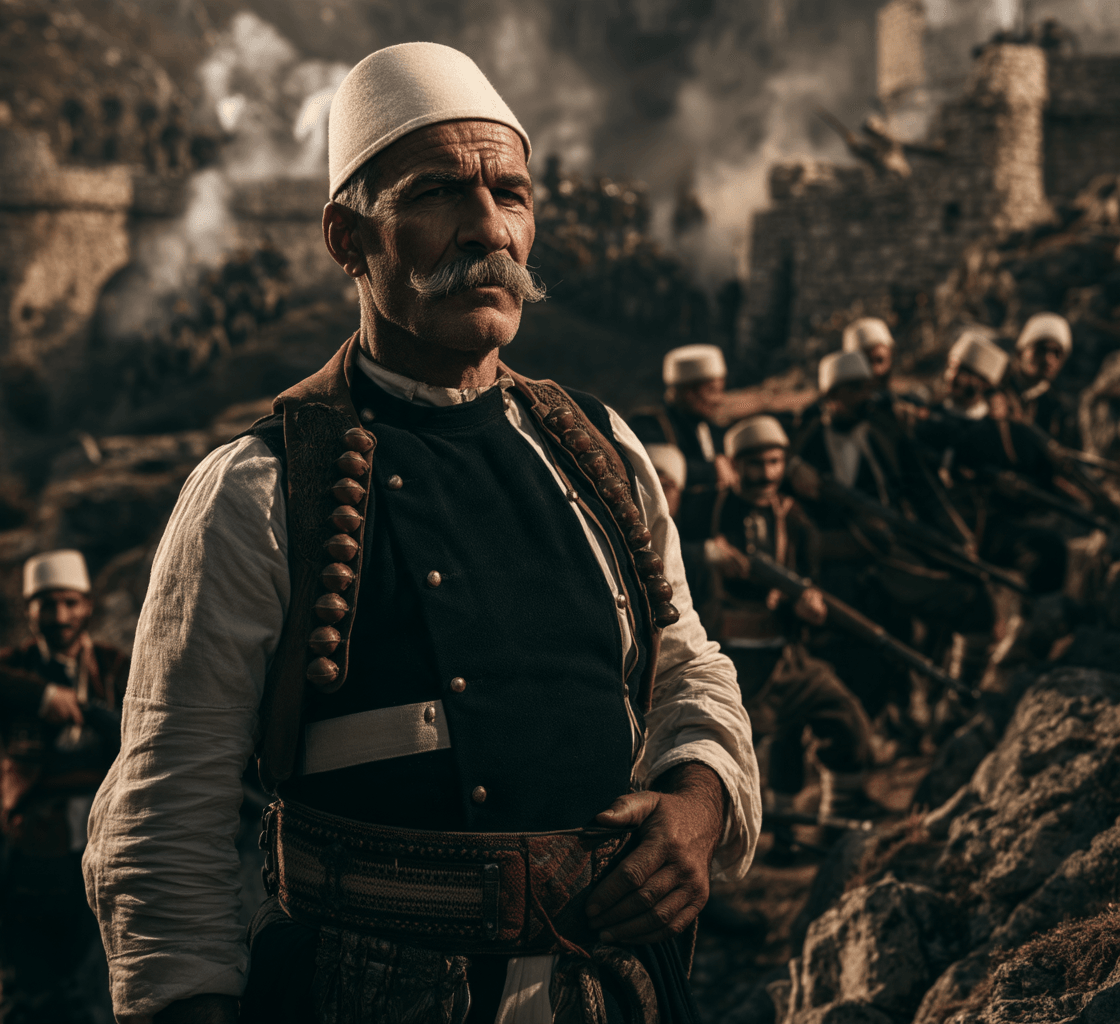
Isa Boletini: The Lion of Boletin
From a besieged stone tower near Mitrovica to the Assembly of Vlora and an ambush at the Ribnica bridge, Isa Boletini gave everything to Albania. Sultans, tsars and kings tried to buy him, and none succeeded.
Isa Boletini was born on 15 January 1864 in the family's tower at Boletin, near Mitrovica, to Ademi and Aishe. The family belonged to the Maksutaj brotherhood of the Shala tribe and had come from Isniq of Deçan. It held land, stone quarries and the Majdan mines, and made work tools that were sold beyond Kosovo. Isa grew up among flags and the repeated blows the Ottoman army dealt to that tower complex, and he joined the national movement at sixteen or seventeen. He took part in the Battle of Slivova on 22 April 1881, after the League of Prizren, and stood with the delegates of the League of Peja around Haxhi Zeka.
In 1902 Russia demanded a consul in Mitrovica, a man who would stand for Serbian interests in the heart of Albanian land. Isa answered by seizing smuggled weapons and disarming the Serbs. In Kolasin he collected more than 1,500 rifles, which the elders said the Russian authorities had handed out. Sultan Abdulhamid summoned him to Istanbul. Isa went only on condition that the consul not be placed in Mitrovica and that his fighters keep their arms. He refused the palace's offers of titles and money, saying he preferred to stay near his children and countrymen. The years 1902 to 1906 were a soft internment, a way of keeping him away so that the consulate could open. Isa insisted on returning home. When Russia was dragged into war with Japan and lost its strength, he went back to Kosovo in February 1906, to enormous enthusiasm.
In 1908 at the Assembly of Ferizaj, Isa openly voiced his doubts about the Young Turks. He said that after winning they would break their promises, just as Abdulhamid had done, and demanded autonomy as the price of Albanian support. He was right. Taxes rose, conscription was forced on the highland boys, and Albanian schools were closed. Xhavit Pasha marked Isa for elimination, and Boletin was besieged and bombarded. Isa was wounded, broke the ring and withdrew, while the tower burned. He organised the Assembly of the Elders at Isniq in April 1910 and then held the pass at Çernaleva with Idriz Seferi at Kaçanik, striking heavy blows at Shefqet Turgut Pasha's far better armed army. Montenegro's King Nikola offered weapons and money, but Isa refused: he fought to preserve Albania, not to swap one master for another.
In Vlora he was honoured to the full. Ismail Qemali wanted him at his side and offered him a place in the government, and Isa declined, choosing instead to head the first Albanian guard. In London he stayed with Aubrey Herbert, and when Sir Edward Grey joked that the English would disarm him, Isa answered that nobody had disarmed him: his nagant was thrust into his traditional clothes. To the press he said he would fight Serbs, Greeks and Montenegrins until death. He stood by Prince Wied's state and the Albanian state itself, not by any single ruler.
In 1916 he was drawn out of Shkodra toward Montenegro, believing the French consul had arranged his safe exit from the Balkans. At the Ribnica bridge in Podgorica, Montenegrin troops lay in ambush. They demanded that he surrender and disarm, and he refused. He fell rifle in hand on 23 January 1916, with his fighters, among them two of his sons and three nephews. Montenegro had also killed Çerçiz Topulli in 1915, and the pattern is plain: the men who stood against the dismemberment of Albania were eliminated one by one. The Boletin family lost its tower and land to confiscation, but his name is carried today by schools, streets and squares across Albanian lands, because for him the only ideal was the nation.