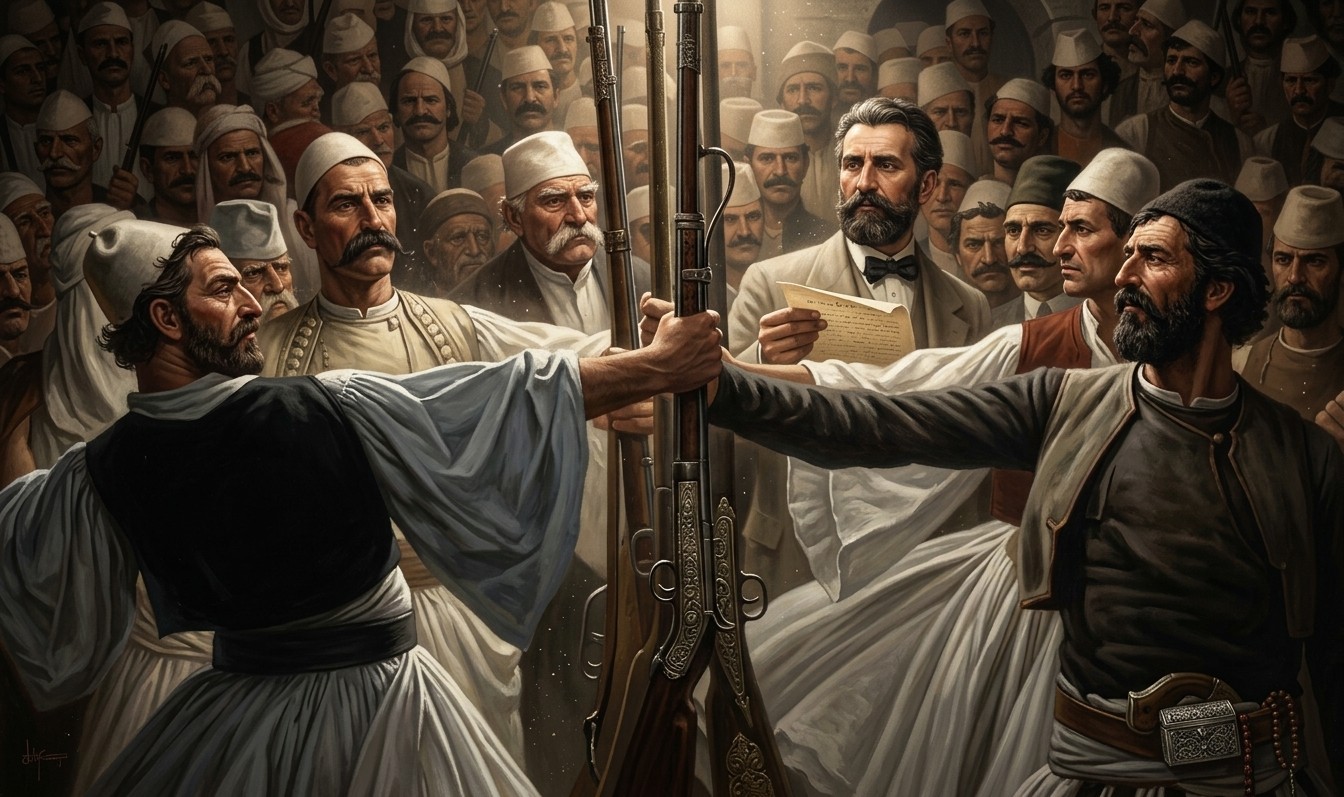
Prizren, June 1878: The Day the Albanians Clasped Hands
In a city of mosques and madrasas, over a hundred delegates set aside their quarrels and gave the Albanians their first government and their first national program. Crushed in 1881, the League of Prizren still opened the road to Vlora.
June 1878 looks, at first glance, like a date that says little. Yet in Prizren the first step was taken in the awakening of the Albanians to a state of their own, after five centuries of Ottoman rule. The Eastern Crisis was tearing at the Balkans. Russian armies had pushed deep into Ottoman territory, Serbs had reached Gjilan, and Montenegrins had taken Ulcinj. Under the Treaty of San Stefano, nearly half of the Albanian lands were handed to Slavic neighbors, and Albania was to be torn between four states. The Albanians had stood outside the Tanzimat reforms and found none of their rights in them. Now their very territory was on the auction block.
Istanbul tried to seize the moment. Sultan Abdul Hamid II, with his pan-Islamist ideas, summoned the leading Albanian figures to the capital and pressed them for days to turn the coming assembly into an Islamic Balkan organization. They resisted, and though delayed, they set out for Prizren. On 10 June 1878 the city took on a festive air, filled with guests in the costumes of their regions, armed. More than 110 names are known: landowners, aghas, merchants, craftsmen, clergy, bajraktars, highlanders. They met in a hall of the madrasa built in the 17th century by Mehmet Pasha, beside the Bajrak Mosque, under the oldest delegate, Iljaz Pashë Dibra, called Qokur.
There Abdyl Frashëri spoke of binding the Albanian besa and swearing to defend with blood the lands inherited from grandfathers and great-grandfathers. The delegates were unanimous on the main question: to oppose the partition of Albanian lands at any cost. A general besa was proclaimed, and blood feuds were to cease at once. The League took shape as a political and military organization, with a General Council in Prizren under Iljaz Pashë Dibra and a Committee with three commissions: Foreign Affairs under Abdyl Frashëri, Internal Affairs under Haxhi Shabani, and Finance under Sulejman Vokshi. For the first time, a government separate from the Sublime Porte took shape in Albanian lands, and it functioned, briefly, but it functioned. The demand was autonomy: one united vilayet instead of four. The Ottomans understood perfectly that it was a step toward breaking away entirely.
Berlin, opened on 13 June, turned a deaf ear. The great powers were guarding the status quo of the Ottoman Empire, and the Treaty of Berlin did not even mention Albania's name. Still, the League's units under Sulejman Vokshi took Shkup, liberated Prishtina without a fight, and reached Mitrovica, Peja, Ferizaj and Vushtrri. They expelled Turkish officials and seized the railway bridges. The sultan would grant nothing, and Dervish Pasha marched with his battalions. At Slivovë, Mic Sokoli rushed with his men toward the Turkish guns and fell before their muzzles. At Shtimje the fighting was bloodier still. About 1,200 Albanians and 800 Turkish soldiers died. On 23 April 1881 Dervish Pasha entered Prizren, declared a state of siege, and arrested and sentenced some 7,000 people.
The leaders paid dearly. Ymer Prizreni refused every pardon and office and died in exile in 1884. Sulejman Vokshi was hunted for years in the highlands of Gjakova, then captured and punished. Abdyl Frashëri was taken at the ford of Bupçi, sentenced to death, then to life imprisonment, and died in 1892 under police watch in Istanbul. Yet the League had challenged the great powers, the neighboring monarchies and the arrogance of the Porte, and its example became the guide for every movement that followed, until the flag of independence rose in Vlora in 1912. If, in another time and another mentality, the leaders of that era could set aside region, religion and class and clasp each other's hands for a single aim, the good of the Albanians, then that is the lesson Prizren still holds.