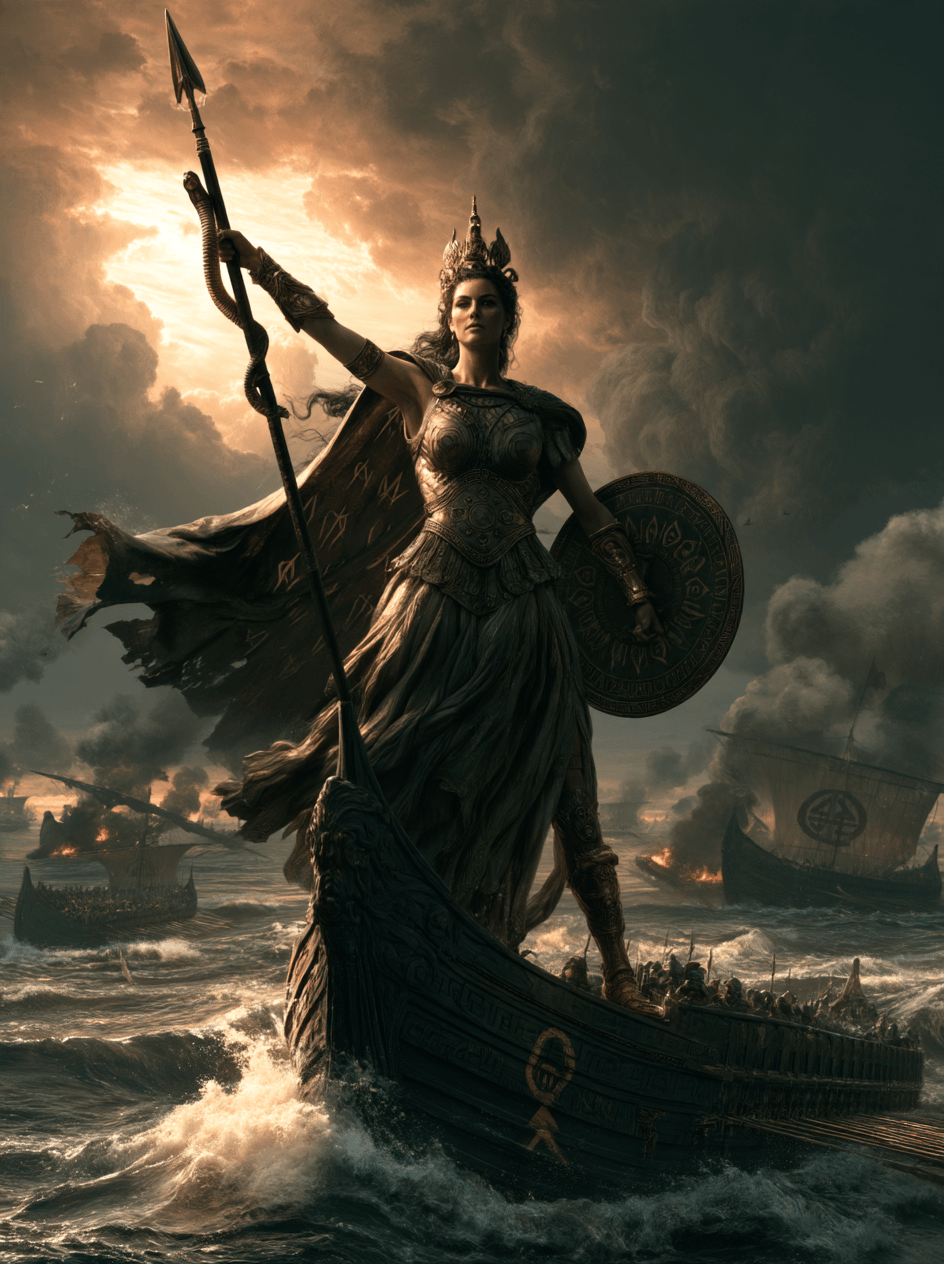
Queen Teuta: The Illyrian Queen
In the winter of 229 BC, two Roman envoys stood before Queen Teuta to protest Adriatic piracy. Within a year, a Roman fleet lay off the Illyrian coast, and Rome had crossed that water for the first time.
Two Roman envoys, the brothers Gaius and Lucius Coruncanius, came before an Illyrian court with a complaint about piracy in the Adriatic. The queen who heard them was Teuta, regent of the Ardiaean kingdom, the strongest Illyrian power of its day. She told them she would see to public wrongs, but that it was not the custom of Illyrian sovereigns to forbid private subjects from taking prizes at sea. One envoy answered sharply that Rome would make it her business to reform the relations between sovereign and subjects in Illyria. On the way home, he was killed. Within a year, Rome sent an army across the Adriatic for the first time.
Teuta did not come to the throne in her own right. She was the wife of King Agron, who had built the most formidable land and sea forces any Illyrian king had commanded. In 231 BC his men broke an Aetolian siege at Medion, and he died soon afterward, felled by pleurisy after the celebrations. He left a young son, Pinnes, and a widow to hold the kingdom together. Teuta governed as regent from about 231 to 227 BC. She did not invent Illyrian sea power. She inherited a navy and a raiding economy already in motion, at the height of the kingdom's reach, and she had to decide what to do with them.
Her armies raided Elis and Messenia in the Peloponnese. On the way home they seized Phoenicia, the richest city in Epirus and a hub of trade with Italy. Taking a city, not just plundering the countryside, was an escalation, and Illyrian raiders were also stripping Italian merchant ships in great numbers. Rome had ignored earlier complaints. Now it sent the Coruncanii to Scodra. They found Teuta celebrating the end of an internal rebellion while her forces prepared to besiege Issa. The killing of an envoy, a grave offense in the ancient world, gave Rome its reason for war. Whether Teuta ordered it or not, the story survives only as the Romans told it.
In 229 BC Rome sent roughly 20,000 infantry, 200 cavalry and a fleet of 200 ships under Gnaeus Fulvius Centumalus and Lucius Postumius Albinus. The blow caught Teuta with most of her ships committed to Corcyra. When the Roman fleet appeared, her governor Demetrius of Pharos betrayed her and handed the city over. Her coalition came apart. City after city fell, and Teuta withdrew to the fortified town of Rhizon, the main base of her fleet, on the Bay of Kotor.
In the early spring of 228 BC she sent her representatives to Rome and accepted harsh terms. She would pay annual tribute, rule only a narrow region north of Lissus, now Lezhë, sail no farther south than that city with more than two unarmed ships, and acknowledge Rome's ultimate authority. Demetrius was rewarded with Pharos and the adjacent coast. Cassius Dio records that she abdicated in 227 BC. Appian records an embassy to Rome that handed over captives and apologized for what had happened under Agron, but not for her own rule. After that, the sources fall silent. No death, no exile, no last word. We know her only through those who defeated her, but those writers could not leave her out, because she ruled at the moment Rome turned east.
That is why Teuta is still a household name in Albania, Kosovo and the diaspora. She is the rare Illyrian whose decisions were written down at all, a woman who held the highest authority in the land at a moment of crisis and faced down a rising empire. Her name was revived in the Rilindja, the national awakening, and today Albanian families from Tirana to New York give it to their daughters, a small, deliberate act of memory that carries the deep past into the present.