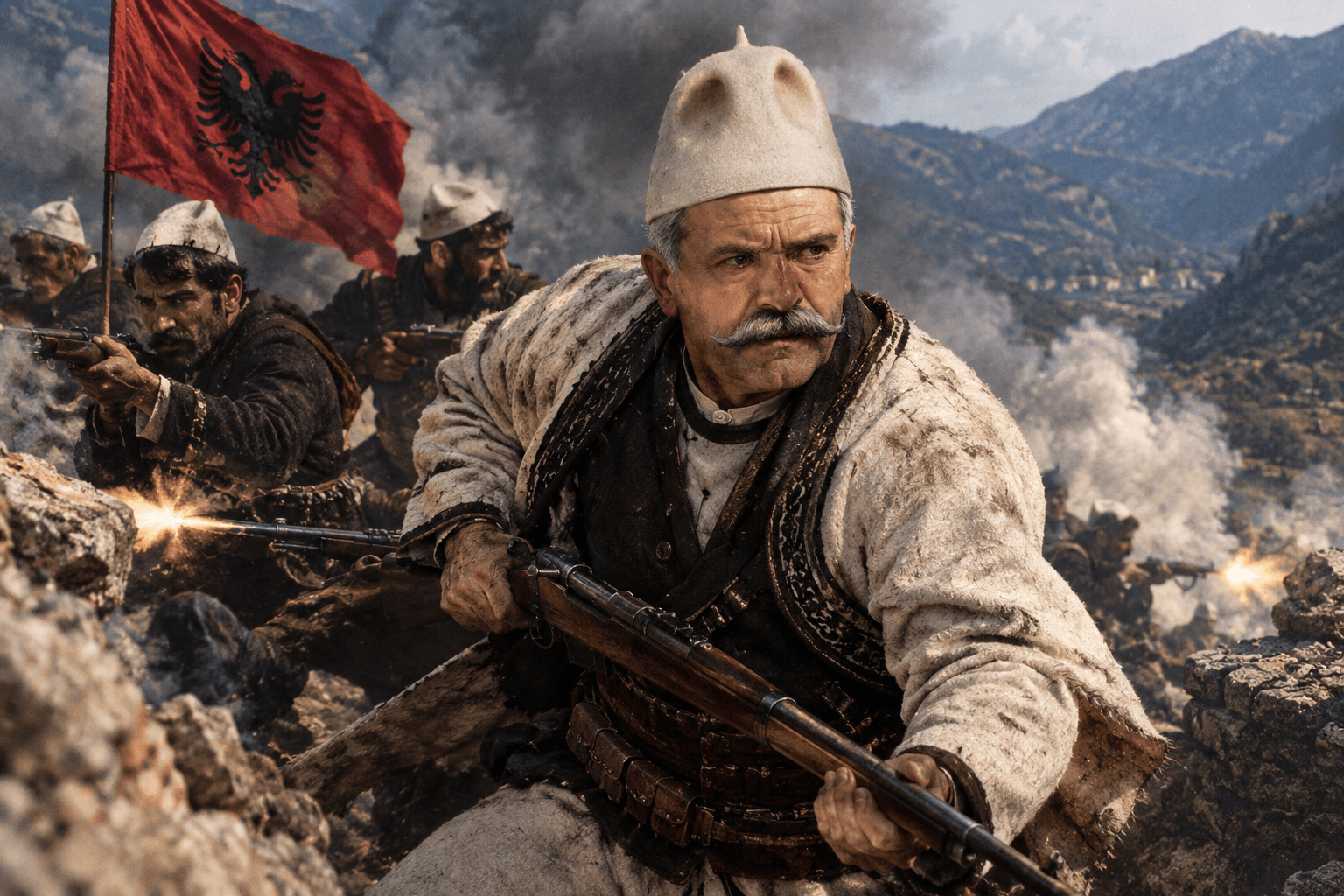
Selam Musai: The Man Who Seized the Cannon by Its Muzzle
Born in the mountain village of Salaria, a former Ottoman conscript who learned war in Yemen became the commander of the Tabors of Tepelena. In June 1920, at the pass of Koçiu above Vlora, he chose a sacrifice that would not die.
Salaria was once a large village of 940 inhabitants and more, but its wild position and hard roads have emptied it until barely 30 families remain. Out of those mountains came Selam Musai, born into a family with traditions. He was not an educated man, but he was a born patriot. Conscripted against his will as a nizam, he served six years in Yemen, where he learned the military art and the strategy that would one day make him a war leader. Back in Albania, he rebuilt the family economy, but the national question became the most important thing in his life.
His house became one of the centers of the national movement. Bajo and Çerçiz Topulli, Osman Haxhiu, Sali Butka, Mihal Grameno, and as far as Avni Rustemi passed through its doors, and many actions against the occupiers began there. A wealthy and famously generous family, they gave the bands money, gunpowder and arms. In 1911 his name stood among the 43 band chiefs who signed the memorandum of Çepo, an assembly of more than 800 men that broke the attempt to isolate the uprising in the north and leave the south for Greece to annex later. In the Balkan War of 1912, wounded at Bezhan, he refused to withdraw. When news came that independence had been declared, he rose and said: "Boys, we will rise again, because in the end we have our own state."
The year 1914 brought the Greek andartes and the burning of more than 300 villages across the south and southeast. Selam met them at Delia, where his arrival stopped the reprisals and left 18 Greek soldiers dead. At Gribë, with about 70 fighters at first and then about 120, he faced Captain Leroi, a man with the myth of invincibility, who was killed by Selam's friend Ali Rakip Laka. The Greeks left more than 200 dead against eight Albanian dead and 22 wounded. Then came Ormovë, where 217 villagers were locked in the church and killed on April 29. Selam led the revenge: Rruzat, Luzat, Lekël, Tërbuç, Labovë, a night attack launched two hours before dawn, and a hand-to-hand struggle at Little Labovë, one of the bloodiest battles of the year. Wounded at Tërbuç, he went to the hospital in Tepelena and returned to the front.
In 1920 the fight turned toward Vlora, held by Italian troops. Before leaving, he forgave the blood of his brother to the Kordha family so that all could fight together. At Nivicë the Committee for National Defense named him commander of the Tabors of Tepelena, part of more than 2,000 fighters from the region. On June 5, at Kotë, his men took the eastern flank, defended by artillery and infantry, and fought through the night, hand to hand. On June 11 he led the Tepelena fighters into the massive attack on Vlora, killed an Italian colonel, and pushed deeper than any other group, to the area above the hospital.
At the pass of Koçiu, Halim Xhelo would call it the battle of the Spartans of Labëria. Italian cannons were firing without pause on the exposed Albanian fighters, and Selam threw himself among them to show that the Albanians would not retreat, sparing his comrades. His brother and the others searched for his body, and with it that of Dule Dalani, who stood beside him to the end, but they never found them. In September the Albanian troops entered liberated Vlora. The folk song still sings of a heart of steel who rushes like a dragon and seizes the cannon by its muzzle. He was not fighting for property or for pastures, but out of a patriotism forged over centuries by his ancestors, which let men like him see beyond their own region. Here every stone is washed with blood: men of the mountains, men who never fall.