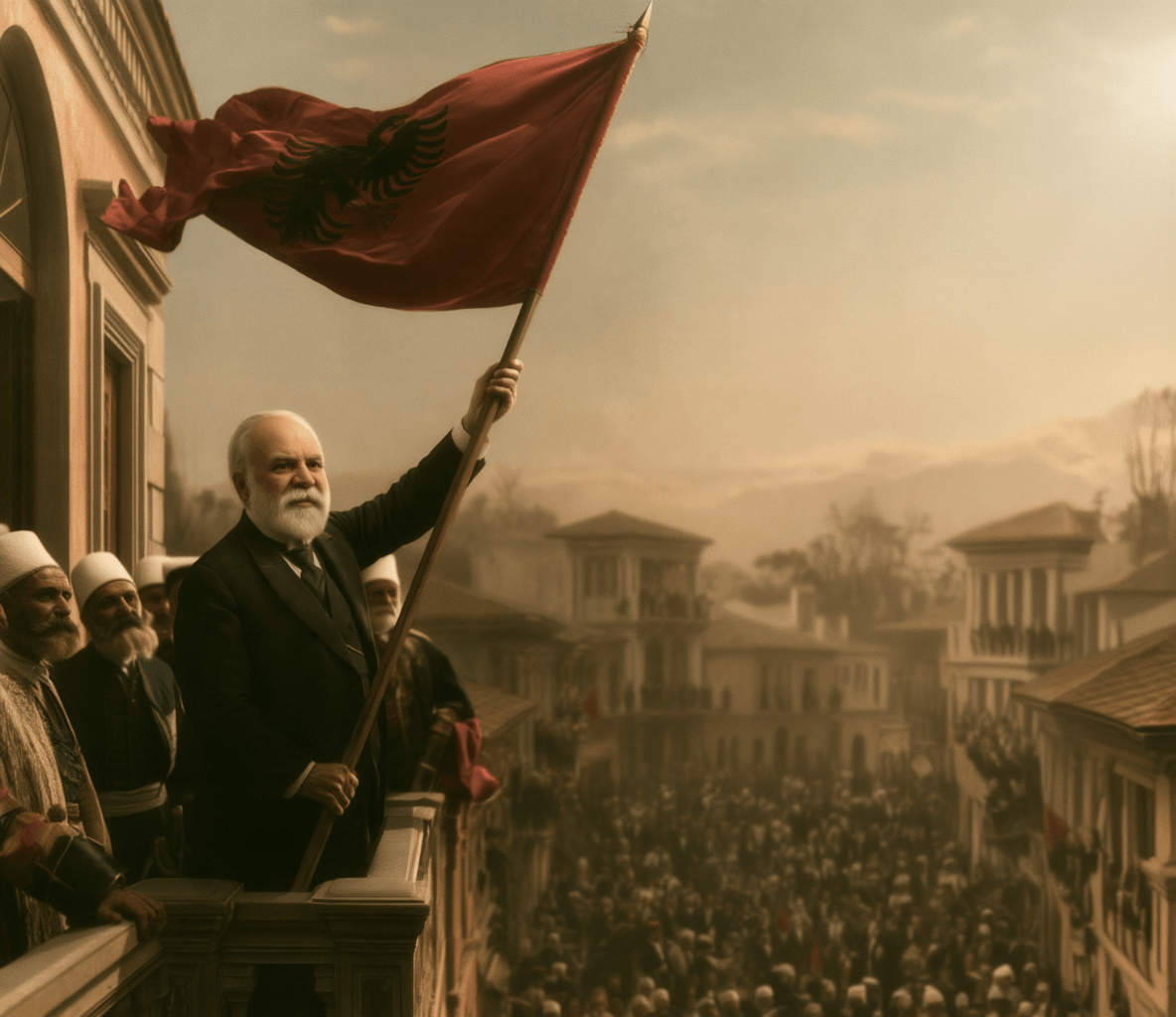
The Flag in Vlora: Albanian Independence on 28 November 1912
On a grey November day in 1912, Ismail Qemali and delegates from across the Albanian lands declared Albania free and independent, while the Balkan armies closed in. It was the work of Albanian will and European calculation, and its founding document later vanished.
On 28 November 1912, in Vlora, the delegates of the All-Albanian Congress listened as Ismail Qemali laid out the danger facing Albania. Each kaza counted as one vote, and the answer was unanimous: Albania, from that day on, would be on its own, free and independent. They rejected the autonomy the Ottomans had granted the Albanian Vilayet only months earlier. Qemali raised the flag of Skanderbeg from the balcony of his house before the gathered crowd. The Balkan armies of Serbia, Greece, Montenegro and Bulgaria were already sweeping across the lands Albanians claimed, and the only way to stop the carving-up was to stand as a state.
The road to that day had been long, and Albania was the last in the Balkans to take it. The Ottoman system had kept Albanians split across four vilayets, and Albanians had no unity. Many of them had been absorbed into the Ottoman order, with grand viziers and pashas serving the empire rather than a homeland. Roads, railways and ports had been neglected. Albanians also lacked a single class or tradition of rule to carry a national cause. The uprising of 1912, which carried Albanian rebels as far as Skopje, forced the Ottomans to yield, but it was the outbreak of the First Balkan War in October that turned the movement from autonomy to independence. Ismail Qemali, a liberal and a diplomat trained by Mid'hat Pasha, first spoke of an independent Albania only on 20 November, eight days before the flag went up.
Independence was not won by Albanians alone, and it was not handed to them alone either. Austria-Hungary and Italy refused to see a Serbian port on the Adriatic, and Vienna pressed Qemali toward independence rather than autonomy. Inside Albania, Isa Boletini's fighters from Kosovo formed the first core of an army and defended the few square kilometres the new government held around Vlora, Berat, Fier and Lushnja. Without the internal movement the European powers would have had nothing to back, and without the powers that movement could have been crushed, as other stateless peoples have been. The strength of the Vlora act was symbolic. Qemali gave Albanians a flag and a state at the moment it was needed, and without that gesture no one can say what would have followed.
The price was heavy. The Treaty of London in May 1913 gave Kosovo, Cameria and large northern and southern lands to Serbia, Montenegro and Greece, and left roughly a third or more of the Albanian people outside the borders of the new principality. The Great Powers refused to recognise Qemali's government, installed an International Control Commission, and in 1914 brought in a prince. Qemali was forced out. This late and truncated independence left Albania smaller than it deserved to be, and it cast a long shadow over the century that followed.
Even the memory of that day is fragile. The famous photograph of the balcony was taken a year later, on 28 November 1913, and no photograph of the proclamation itself exists. The original declaration, with its 37 signatures, was kept by Lef Nosi, who in 1937 had it published so that every Albanian family could hold the birth certificate of their state. After his arrest in April 1945 the trail went cold, and it has never been found. Whether it was taken by the security services, shipped off with other papers, or lost in some other way, Albania's founding document is missing, and we owe Nosi the copies that survive.