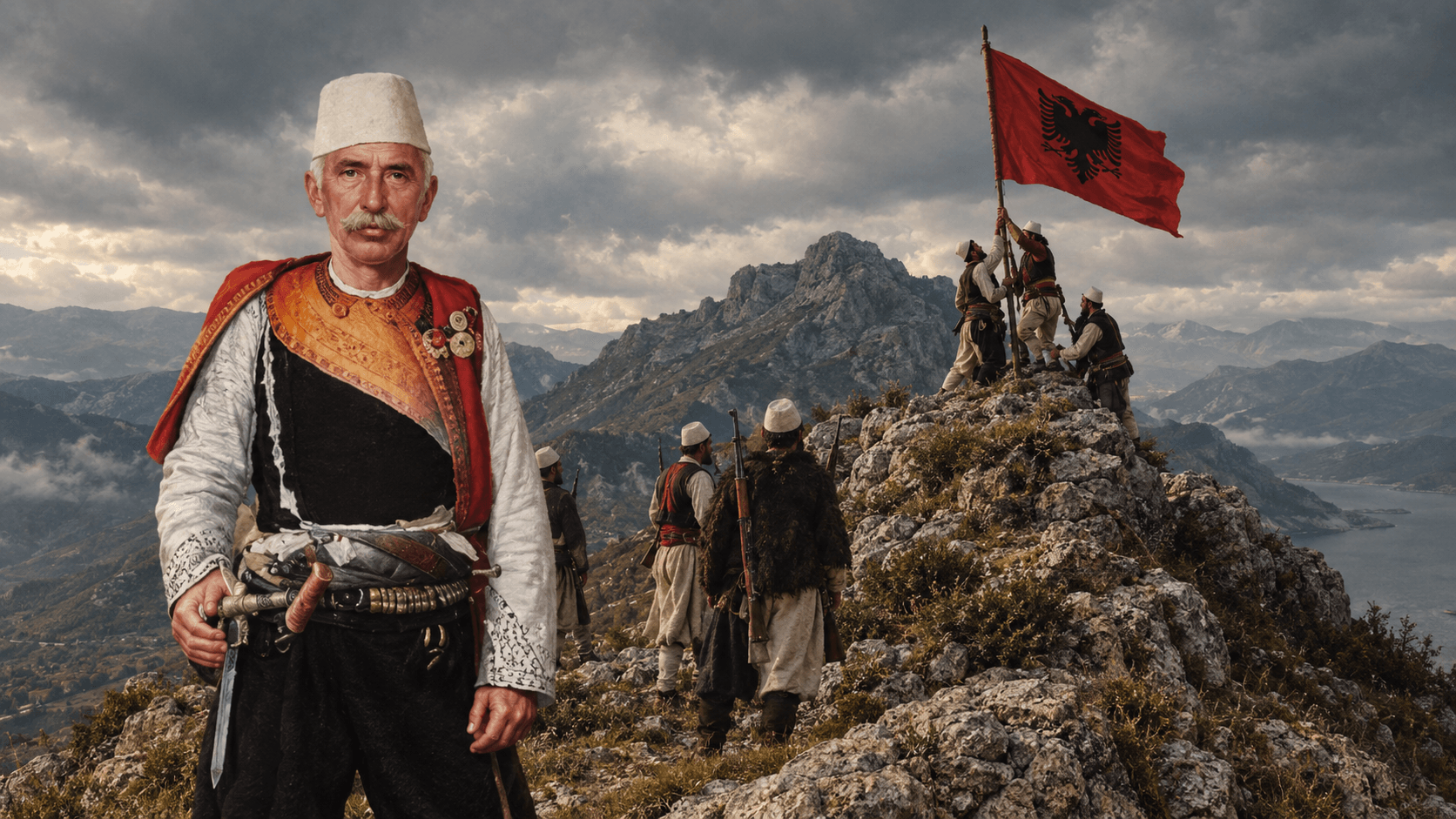
The Flag on Bratila: Dedë Gjo Luli and the Highlands That Would Not Bow
On 6 April 1911, a red-and-black flag rose over the peak of Bratila, and the man behind it was a small, self-taught commander from Hot. This is the life of Dedë Gjo Luli, from orphaned boyhood to a death still wrapped in shadow.
Dedë Gjo Luli was born in 1840 in Bardhaj, in Traboin of Hoti, a rugged highland region whose communities had a long tradition of self-government and resistance. His father, Gjo Luli, died before Dedë had reached the age of two. He was raised by his uncle, Gjelosh Luli, and his uncle’s wife, Dilë Hasanja of Kastrati. He later married Prenda Gjeloshi, a woman from Gruda. The customs, traditions and discussions of the highland odas, where elders gathered to debate alliances, justice and the defense of their lands, helped shape his character from an early age.
By 1878, Dedë Gjo Luli had emerged as a representative of Hoti and Traboin at the League of Prizren. In 1879, he joined the highland chiefs who petitioned the Great Powers against the partition of Albanian lands and the proposed transfer of Hoti and Gruda to Montenegro. He continued to defend the rights of the highland communities through resistance, political assemblies and appeals to foreign representatives. Accounts of his life also associate him with an 1883 memorandum sent through the British consul to Queen Victoria, pledging to defend Albanian rights by force of arms.
The authorities responded to resistance with punitive campaigns, and several settlements suffered destruction. Dedë became a wanted man, forcing his family to seek refuge among friends and allies in neighbouring highland communities. He himself continued to move through the mountains, relying on the loyalty of local families and the protection of fortified towers. His family’s history would remain closely tied to the struggle to preserve their lands and traditions.
Physically small, Dedë was nevertheless respected for his wisdom, composure and determination. He was a self-taught military leader who had never attended a formal military academy, yet his reputation drew chiefs and fighters from Hoti, Kelmendi, Gruda, Triesh, Koja, Kastrati and Shkreli around him. He understood that the defense of Albanian lands required unity across religious and regional divisions. He participated in the political movement that culminated in the League of Peja in 1899. When the Franciscan poet Gjergj Fishta visited the highlands in the early twentieth century, the stories of Dedë and his fellow warriors became part of the national memory later immortalized in Lahuta e Malësisë. Abbot Preng Doçi was among the prominent national figures associated with Dedë’s political circle.
The suppression of the Kosovo uprising in 1910 and the arrival of Shefqet Turgut Pasha, who pursued the disarmament of the Albanian highlanders, brought the region to another turning point. For a highlander, surrendering his rifle meant far more than losing a weapon: it threatened his independence, his family’s security and his ability to defend his community. Many Albanians sought refuge in Montenegro, where the Committee of Podgorica became an important centre of political and military activity.
Montenegrin ruler King Nikola I initially offered support to the highlanders, but his own territorial ambitions soon became apparent. According to the accounts surrounding their negotiations, the king expected Montenegro’s flag to fly over the highlands after victory. Dedë rejected the idea that the Albanians should exchange Ottoman rule for another foreign domination. His reply, remembered in highland tradition, conveyed his determination: they had begun the struggle without the king and would finish it without him if necessary.
On 24 March 1911, the uprising spread through Hoti and the neighbouring highlands. Fighters from Rapshë, Pikalë, Gruda, Kastrati and Shkreli joined the movement, and on 28 March the insurgents captured Tuzi, an important position in the region. Dedë Gjo Luli and the brave fighters of Hoti became central figures in directing the revolt, which soon grew beyond a local struggle into a national movement.
On 6 April 1911, after fierce fighting around Mount Deçiq, the Albanian national flag was raised at Bratilë, a prominent height associated with Deçiq. Historical accounts identify Dedë’s cousin, Nikë Gjelosh Luli, as one of the men who raised it, alongside Gjo Ujk Miceli and Pjetër Zefi. Dedë was the uprising’s leading commander, but the accounts naming the men who physically raised the flag should be distinguished from accounts describing his leadership of the operation.
The flag’s arrival in the highlands is associated with the patriot Palok Traboini and with Aladro Kastrioti, who is linked in historical accounts to its provision. Some versions differ over the intermediary involved and the precise route by which the flag reached the highlanders. The famous photograph associated with the Marubi photographic tradition helped preserve the memory of the flag and the insurgents.
The raising of the flag at Bratilë was a landmark in Albania’s national movement. It demonstrated that the highlanders’ struggle was not merely a local revolt against Ottoman rule, but part of a broader demand for Albanian national rights and self-government.
The fighting continued through the spring of 1911. Negotiations and temporary ceasefire arrangements failed to bring a lasting settlement, and Ottoman forces resumed their attacks. Although the insurgents were eventually forced to abandon several strategic positions, the uprising had already changed the political landscape.
On 23 June 1911, the leaders assembled at Greçë, in the highlands of Malësia e Madhe, and adopted the Memorandum of Greçë, commonly known as the Red Book. Luigj Gurakuqi played a central role in preparing and presenting the document, while Ismail Qemali supported the wider national programme. The memorandum demanded recognition of the Albanian nationality, territorial and administrative autonomy across the four vilayets, and the use of Albanian in education and administration.
The memorandum represented one of the most developed political programmes of the Albanian national movement before independence. It connected the armed struggle in the north with the wider aspirations of Albanians throughout the country, including the southern regions. The demands advanced at Greçë helped demonstrate that the movement was seeking national rights and a common political future, rather than simply defending the interests of individual highland communities.
The following years brought further tragedy. In 1912, Dedë’s son Gjergji was killed in the fighting associated with Qafa e Kishës. The Balkan Wars that began that autumn created another crisis for the highlands. When Albanian fighters sought to raise their national flag again at Bratilë, Montenegrin forces opposed their efforts. The region suffered occupation and renewed violence, affecting both Christian and Muslim Albanians.
Shkodër endured a siege lasting approximately six months, while the highlands experienced military occupation and displacement. Dedë could not travel to Vlora for the declaration of independence on 28 November 1912. The proclamation established the independent Albanian state, but it did not settle the question of the northern territories.
In 1913, the London Conference assigned important parts of the highland territories, including Hoti and Gruda, to Montenegro, dividing communities whose political and social lives had long been interconnected. Dedë continued resisting the separation of Albanian lands and opposed the imposition of a border that disregarded the wishes of the local population.
In 1914, he was associated with the defense of the Principality of Albania in Durrës, alongside patriots including Isa Boletini and Bajram Curri, against the ambitions of Essad Pasha Toptani. Even in old age, Dedë remained committed to the defense of Albanian independence and territorial integrity.
On 29 June 1915, at Kallmet in the region of Lezhë, Dedë is reported to have written his testament. His wife was Prenda Gjeloshi, while Nora of Hoti was the wife of his son Kolë and became an important figure in the family’s later history.
In September 1915, Dedë travelled towards Mirditë for a meeting with local leaders. On 24 September 1915, he was killed at Sheshëz, near Orosh in Mirditë, after falling into the hands of Serbo-Montenegrin forces and their local collaborators. His death occurred during a wider period of violence against Albanian political and military figures who continued to resist foreign domination.
That same summer, Çerçiz Topulli and Muço Qulli were killed by Montenegrin forces near Shkodër on 17 July 1915. Mehmet Shpendi had been killed two days earlier, on 15 July, in the area of Ndërkisa near Qeresh in Plan. Isa Boletini was killed in Podgorica in January 1916. These separate tragedies formed part of the devastating circumstances confronting Albanian patriots during the First World War, although any claim that they resulted from one coordinated plan should be supported by specific documentary evidence.
Dedë’s son Kolë died in 1918, reportedly as a result of poisoning, although accounts differ over the exact circumstances. The loss of Dedë and his sons devastated the immediate family, whose history became inseparable from the sacrifices made in the struggle for Albania.
The family’s tower in Traboin, built and rebuilt after repeated destruction, became a lasting symbol of resistance. Local accounts state that it was burned six times. The flag associated with the uprising at Deçiq was preserved for years by the Franciscans of Shkodër and was later placed in the city museum.
The raising of the flag at Bratilë on 6 April 1911 remains Dedë Gjo Luli’s most enduring historical legacy. He helped transform the resistance of the highlands into an expression of the Albanian national cause, demonstrating that the struggle for freedom was not confined to a single region. His name remains inseparable from Deçiq, the flag and the generations of Albanians who continued to fight for an independent and united homeland.