The Unbroken Voice: How Albanian Survived the Millennia
From the earliest human migrations across Eurasia to the present day, the Albanian language carries within it the echoes of an ancient past—a linguistic archive that connects modern Albanians to civilizations that shaped the Balkan peninsula over eight thousand years ago.
Language has stood as humanity's most remarkable testament to our capacity for communication and connection. Dating back 270,000 years to the age of Y-chromosomal Adam, our ancestors transformed grunts and gestures into sounds, eventually birthing the first rudimentary forms of expression. As humans migrated and diversified across the world, these communications gradually evolved into distinct branches and families. The Indo-European language tree—the family to which Albanian belongs—underwent remarkable transformations over millennia, shaped by migration, war, and isolation into the form we know today.
For the past two centuries, scholars have debated the origins of Proto-Indo-European. One camp argued that early farmers from the Fertile Crescent in southwest Asia, perhaps 9,500 years ago, carried these languages with them. Another insisted that nomadic herders north of the Caucasus Mountains, riding horses and wheeled wagons across the Eurasian steppe around 5,000 years ago, were the true dispersers. But in 2015, Russell Gray and Paul Heggarty from the Max Planck Institute assembled over 80 experts to challenge these prevailing theories entirely. By constructing a revolutionary database using fundamental concepts like numbers, water, and color, and by harmonizing linguistic data with insights from archaeology, anthropology, and genetics, they worked backwards from Classical Latin to pinpoint the true age of the Indo-European mother tongue. Their findings, published in Science in July 2023, revealed that the Indo-European languages originated and expanded with early farmers native to lands south of the Caucasus more than 8,100 years ago. Around one thousand years later, this branch split into seven major branches that spread across the Eurasian steppe—a secondary migration, not the ultimate origin.
The significance for Albania became unmistakable when Heggarty pointed to the ancient genetic heritage of the Albanians reaching the Illyrian peninsula more than 8,000 years ago. The E-V13 genetic subgroup, which carries this heritage, remains remarkably widespread in European populations today, with Albanians from Kosovo showing the highest concentration at about 45% of the population, followed by mainland Albanians at 36%. When asked if the Albanian language itself is 8,000 years old, Heggarty was decisive: the Albanian language is not that ancient, but its archaic branch is one of the first in the Indo-European language tree, surpassing both Armenian and ancient Greek. This places Albanian at the very foundation of European linguistic development.
Albanian linguists have reinforced this ancient lineage through meticulous scholarship. Elena Kocaqi, a professor of history, presented a compelling case linking Albanian with the Homeric language through historical evidence and etymology. Examining the complete Homeric lexicon of 8,844 words, Kocaqi extracted the etymology and morphology of hundreds of words, revealing that the Homeric dictionary is more tied to Albanian words than to Greek itself. Remarkably, within the Homeric language itself, words from both Geg and Tosk dialects—the very dialects still spoken by Albanians today—appear woven throughout the ancient texts, suggesting an unbroken continuity stretching back thousands of years.
Archaeological excavations have now added tangible proof to this linguistic evidence. In collaboration between Albanian and Swiss archaeologists from the University of Bern, led by Professor Albert Hafner, a submerged prehistoric settlement was uncovered near Pogradec in Albania in 2023. The sediments discovered there are approximately 2,000 years older than comparable finds in Switzerland, possibly stretching back 8 to 9,000 years old. With each layer unearthed, the story of human presence and advancement in Albanian territories comes alive, weaving together the narratives of past generations and revealing the deep roots that have anchored the Albanian people on the Balkan peninsula for millennia.
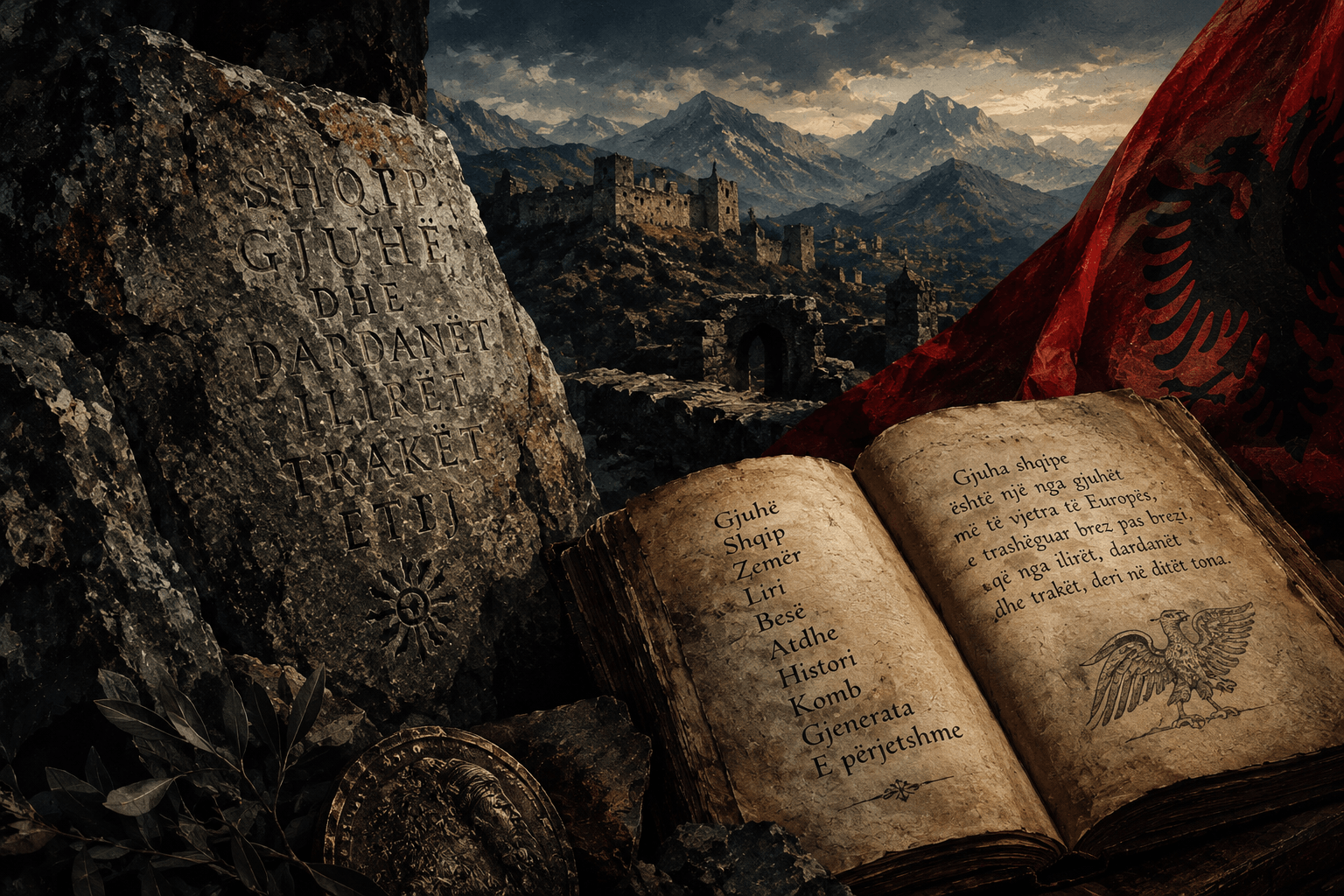
Despite facing numerous invasions by conquering empires, enduring linguistic suppression, and suffering forced displacements from their homes, the Albanian people have consistently demonstrated an extraordinary ability to adapt and survive. Their language became a symbol of resistance during Ottoman rule, when the use of Albanian in schools and official settings was discouraged or forbidden. Families spoke it at home, poets preserved it in verses, and patriots risked their lives to teach it. The unified alphabet adopted at the Congress of Manastir in 1908 was more than a linguistic decision—it was a declaration of identity, uniting Albanians across regions and religions. Today, spoken by over 7 million people worldwide, the Albanian language remains a living testament to survival, identity, and continuity, carrying within it echoes of ancient civilizations and the unwavering spirit of a people who refused to disappear.